Friday, June 1, 2012

La Selva Science Day


Karleigh, Rob Cuba, Lena, JJ 

Word of the day - prehensile tail: An appendage that is used by monkeys to grasp objects such as branches, tree trunks, and fruit. This appendage is also used a balancing aid while jumping from limb to limb.
Spider Monkey using prehensile tail while checking us out

Science of the day:
Three-toed Sloth and baby in rainstorm on site

Today as we were returning from our sampling collection we were fortunate enough to witness a mother three-toed sloth carrying her baby down a tree. Sloths are very interesting creatures. They sleep the majority of the day, and wake up mainly to eat and defecate. There are two species of sloths, the three-toed and the two-toed. Both species tend to be nocturnal. Another interesting theory about sloths is that they will only use the restroom at the bottom of their “home” tree. Rainforest soils are very poor of nutrients and feces is a prized commodity. The sloth is essentially nourishing its home tree!

Example of plant biodiversity in the rainforest
                Multiple teams in our group are working on projects that include identifying plant species. This can be a very difficult task, because the most minute details separate one species from another. Many researchers looking to identify a species of plant in the field look for eight main characteristics: 

1.       Is the plant an herb, shrub, fern or other?
2.       Is the plant hairy or hairless?
3.       Are leaves alternate or opposite?
a.       Opposite leaves occur in pairs on the stem
b.      Alternate leaves occur on alternate sides of the stem
4.       Are the flowers symmetrical or asymmetrical?
5.       What are the types of seeds or fruit? Dry, fleshy, wind driven?
a.       Dry fruits/nuts are nuts
b.      Fleshy fruits are the ones we eat, like peaches and apples
c.       Wind driven seeds are like dandelions, very light and easily moved.
6.       What is the color range of the plant?
7.       When does the plant flower?
8.       What kind of environment is it in? Wet or dry?

Question of the day:
          In the rainforest, do you think that the roots of large trees extend deep into the soil? Why or why not?

Thursday, May 31, 2012

Answering some questions....

Good morning from La Selva!

We have been receiving emails from people and we are going to take a moment to answer a couple here.  Brent Nolan asked "how many plant species are in the rainforest?" and "How many animal species are in the rainforest?"

Answer:  More than 50% of the world's plant and animals live in the rainforests around the world and the rainforests only cover 7% of the world.  Here at La Selva, there are 124 mammal species and 72 of them are bats!  We found that there are approximately 1500 flowering plant species and 730 species of trees that can be found in rainforests.  But by far, the most numerous animals in the rainforests are the insects!  Every time we go outside, we see a new beetle we haven't seen before or a bright red dragonfly like we saw yesterday on the hike.  One thing to remember is that there are new species being found and added to these records so the numbers may vary in the information you read about rainforests.

Hope this helped, Brent!

If anyone has a question they would like answered, you can email Judkins@mail.usf.edu and Dr. J can pass along the questions for us to answer.  Hope to hear from you!


Wednesday, May 30, 2012

La Selva Recon

Authors: Aaron, Erin, Rachael, Rob Collins

Word of the day: Secondary succession-  process of regrowth that occurs in an area that has recently been subject to disturbance. There are several types of disturbances that result in the destruction of an ecosystem, such as floods, forest fires and other natural disasters. These disturbances provide new fertile ground for a new generation of vegetation.

Example of gap succession, a type of secondary succession that occurs after a tree falls.


Science of the day: Today we performed a reconnaissance hike in preparation for tomorrow's sampling. As we traveled through the forest we were able to distinguish between areas of primary and secondary succession. Our main focus of our testing tomorrow is the comparison between old growth, new growth and transition forests.

Although we observed a lot of biodiversity yesterday, we were also able to identify many new species today, which included the green and black poison dart frog, a mating pair of great curassows, a troop of white-faced capuchin monkeys, and peccaries.

Great Curassow (male)


Black and Green poison dart frog
Two Toed Sloth

After our recon hike, we ate lunch, showered, then divided and conquered in our groups. Some groups worked on species identification at the La Selva library, others analyzed soil samples in the lab, and others caught up on writing journals, reading, and organizing data.

Today's Culture: We received a question asking the following, "Latin music and dance is so very romantic. How do men and women interact? What kind of roles are traditional."

Salsa music and dancing comprise a subculture of their own. Tradition dictates that the man always leads and the female plays the part of the subdued partner. Its acceptable for both men and women to change dance partners many times. Salsa had its heyday from the 70s to the mid 80s where people danced salsa at all types of different events. Currently, salsa has changed its image and has become increasingly meshed with rock and hip-hop. The traditional dance steps are still popular with the addition of newer hip-hop influenced moves.

Question of the day: Why are the tropics so hot and humid? One of our group member's dive watch even said "ready to dive" because it was so humid out!

Tuesday, May 29, 2012

Stepping into Biodiversity

Authors: Kris, Lena, Kelly

Word of the Day: Castilla elastica, the scientific name for the common species of rubber tree found in the La Selva neotropical rain forest.  This is the cousin of the tree used in commercial rubber production.  

Science of the Day: Today we arrived in La Selva after a four hour drive from La Fortuna.  We immediately unpacked the van and put away our equipment so we could meet with Kenneth and Albert to take an exploratory walk in the rain forest.  On our introductory walk we briefly stepped into the secondary sucession of the neotropical rain forest.  Here we found  many new and interesting animals: 
  • A two toed sloth was nearly mistaken for an epiphyte high in a canopy tree 
  • A crested Guan alongside its juveniles  
  • A green iguana resting on a branch over a river
  • A red eyed leaf frog (as seen in picture to the right)
  • A troop of Howler monkey's calling in the thunder
  • Two species of ants: Leaf cutter ants (the most common) and Bullet ants (very nasty bite and sting)
  • Two species of Motmots: Rufous and Broad beaked
  • A red and black poison dart frog
  • A colony of long nose bats
  • A miniature bat lodged in the crack of a wooden sign post
  • A Caiman, a species of crocodile 
  • A female marine toad
  • Two species of Toucan
  • A pair of Green Parrots, which mate for life
Today's Culture:  We were a hungry bunch of scientists, and to satisfy our appetite we stumbled upon this road side restaurant.  Because this was a small town we had the opportunity to engage in conversation with only Spanish speaking people.  This gave us a chance to explore our knowledge of the language and their culture.     
with our driver Luis (front left).

Question of the day:  The La Selva Biological research facility is a protected natural preserve.  If your back yard was part of the wilderness and  left undisturbed, would it be as bio-diverse as a tropical rain forest?
Unidentified bat species located in highlighted hole

Monday, May 28, 2012

Field day at the Arenal Volcano

Authors: Karleigh, Lena, Rob, JJ
Diagram: http://tolweb.org/notes/?note_id=3920

Word of the Day - Nitrogen Fixers: Microbes that live in plants on land and also found in the ocean, that capture diatomic nitrogen out of the atmosphere to make it usable for the biotic community. All living things are mostly composed of carbon, phosphorus, and nitrogen. Carbon and phosphorus can be introduced to early communities by rocks that contain the elements. Nitrogen, however, does not occur within the Earth naturally. The microbes are the only way to take nitrogen out of the atmosphere and convert it to begin early succession. They are crucial for community development and energy flow through a system.

Dr. Herzfeld aiding in JJ and Aaron's sampling
Today's Science - Today the different groups continued to collect data for their projects in the Arenal Volcano National Park . There are six different research groups that are investigating six totally different subjects. Karleigh and Kelly are studying herbivory by calculating the percentage of surface area eaten on randomly selected species of plants. J.J. and Aaron are using a sensor to measure levels of carbon dioxide emissions from the soil in different habitats. Erin and Lena are measuring the biodiversity of plants and animals along a ten meter transect. Rachael and Kris are surveying the pollinators and plant relationships by observation. Rob and Rob (aka Rob squared or the Robs) are sampling the varying air compositions by bringing water samples into equilibrium with the atmosphere. Brittany and Jamison are collecting soil samples to measure nutrient and pH levels. All of these projects will be used to collectively compare the different ecosystems from the peak of volcanoes to coral reefs.

Last dinner at Arenal Hostel Resort, La Fortuna
Today's Culture - The focus for today is that of our group. BGPG 2012 consists of two professors, Dr. Judkins and Dr. Herzfeld, and twelve students who for the most part are strangers. We are either Biology or Environmental Science and Policy majors. The twelve students have been divided into 3 groups of 4 to divide responsibilities such as cooking dinner, writing the blog entries with a lead author daily, and dedicating time towards the science experiments. The cohesiveness of the group is pretty amazing considering that we have all been thrown together for three weeks in 2 different countries. The professors have continued to give lectures which are enhanced by the field experience. We are all thrilled to continue what is an already amazing study abroad adventure!

Question of the Day: Which of the 6 student projects interests you?  Or describe a project you would conduct if you were able to visit volcanoes, rainforest and coral reefs.  Can't wait to hear from you!


Arenal Volcano Survey Day

Authors: Aaron, Erin, Rachael, Rob Collins

Word of the day: Buttress root- large, wide based roots that extend from the base of a trunk of a tree to provide stability.
The buttress root of the "Tree of Life"- Kapok tree

Today's Science:
 At the start of our trail at Arenal Volcano National Park, fifteen foot high walls of elephant grass flanked our sides. Elephant grass is a pioneer species and has begun to overtake other plant species around the base of the volcano. As we hiked further we entered an area of secondary succession that was more densely forested. Deeper in the forested area we spotted a White-nosed Coati which is an insect eating member of the raccoon family. The solitary male coati our group saw foraged through the leaf litter for insects and then scaled a tree and checked beneath the tree bark for more insects. At one point we heard a bird call that sounded more like a monkey than a bird, it felt like the bird was taunting us because we couldn't seem to find the bird producing the monkey-like call.


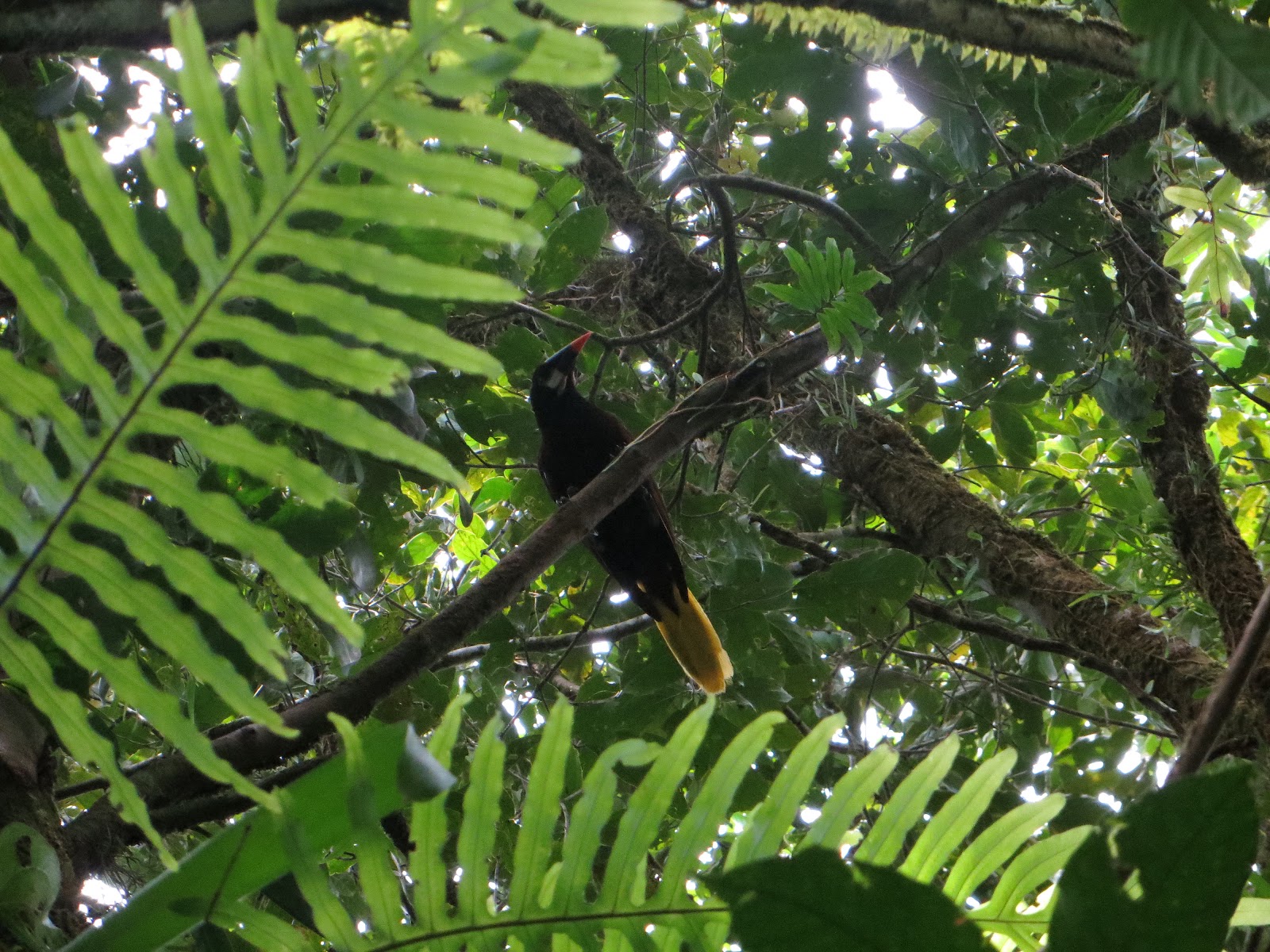
Eventually we tracked down the mystery bird and found it to be a male Montezuma Oropendola. The male tips forward on a branch while spreading its wings while simultaneously making its call to attract females. As if the Montezuma Oropendola wasn't showy enough, he had bright yellow tail feathers, a bright orange beak with two white jowl markings, and a brown body. The trail reached the edge of the pyroclastic flow from Arenal volcano, we scaled the twenty foot high ridge of volcanic rock and found only a few plant species living on the nearly bare rock surfaces. The wax myrtle shrub is a nonnative primary succession species that grows on Arenal's old pyroclastic flows. The shrub arrived in Costa Rica via migratory bird species from the US.

Our trail descended back into the dense forest where we saw numerous other plants and animal species on our way back to the trail head. One of the most amazing sights was the massive Kapok tree, also known as the "Tree of Life". The Kapok tree has buttress roots extending from the base of its trunk to stabilize its extensive branches that reach nearly 200 feet high. The tree is home to many species, like the bats that live in between the buttress roots and that also feed off the tree's night blooming flowers. The tree's canopy provides shelter and food for birds, mammals, insects, and other plants.

Today’s Culture:
The combination of nature and spirituality is a relationship that dates back thousands of years. This holds true with the indigenous people of South and Central America. Their beliefs were often centered around the Kapok tree, which was considered the source of all life. They believed that the roots of the tree extended into the underworld and the branches held up the heavens. The trees were considered sacred for both their spiritual and physical needs. Before harvesting a Kapok tree, the wood cutters of the Taino people needed to receive the blessing of the tree spirit. Even in modern times, the Kapok tree is considered extremely important for a variety of modern products. The large trunks are still used to make dugout canoes, and the fibers of the bark are often used to pad pillows, blankets, and even life preservers. Various parts of the tree, including the bark, seeds, and leaves, have been used to treat dysentery, fever, asthma, and kidney disease.

Question of the day:
What do the terms r-selected and k-selected mean in reference to competition and growth? Which type is the elephant grass considered?  

Saturday, May 26, 2012

La Fortuna or Bust...

Authors: Kris, Jamison, Britt, Kelly

Today was a travel day from Volcano Tirrialba to Volcano Arenal. Even though we did not experience much science today, we created our own as we traveled. We spent time reflecting on ideas for our projects as well as problems we may encounter on the way.

Word of the Day:
Acromyrmex: Scientific name for leafcutter ants
We stopped in La Selva today briefly on our way to Arenal and got a sneak peak view of our rainforest ecosystem. We witnessed a colony of leafcutter ants bringing pieces of leaves to their habitat.


Science Focus:
                                                                  Arenal......or bust
The volcano above shows Arenal, our next expedition. We spent most of the day traveling, took a detour in La Selva to retrieve distilled water, and ended up at Volcano Arenal 7 hours later. We look forward to our next hike up Arenal. Comparing the two very different volcanoes is a collaborative interest in all of our projects.

Culture Focus:

                                             Charging up for the ride with our electrolytes


On our way up Volcano Arenal, we stopped at roadside stands to taste native fruits. In the picture above we are shown drinking out of the Pipa Fria, aka coconut water. The locals use these coconuts to restore their electrolytes after a long laborious day. Pixbae is a cooked fibrous fruit with a taste similar to an artichoke or boiled peanut. We also tried Guavas, a seedpod containing seeds comparable to a sweet cottonball. Exploring exotic fruits on the side of the road gave us a better understanding of the diet of the local people.

Question of the Day:
What different types of fruits would you be willing to try?